Young people learning to listen inward.
An arts-integrated class for young people's mental health. In one-hour classes, students ages 14 to 18 work blindfolded with touch, sound, smell and light, through games, drawing and reflection. We're preparing to study whether it strengthens emotion regulation, social-emotional skills and self-esteem.
First school site is already on board. A Los Angeles youth-serving nonprofit will offer the class as a school-day elective once the study is approved.
Explore
The study
The question, a sample lesson, the measures, the safety plan and the timeline. Kedra is looking for a faculty collaborator to co-lead the pilot.
Read the research → For schoolsThe course
Ten one-hour lessons for ages 14 to 18, being aligned with the California Arts Standards and built around social-emotional learning.
See the course →What can I hear when I set aside what I expect to hear?
From the lesson Sound Made VisibleFrom a proposal to a study across schools.
Scroll sideways to see the whole timeline. Dates from 2027 on are targets.
Co-lead the pilot.
Kedra is looking for a faculty collaborator to co-lead a feasibility pilot. She brings a school site already on board, a curriculum in development, a simple proof-of-concept pilot with a controlled comparison to follow, a mechanism to test, and a three-paper plan. If this work connects with yours, in any field, she'd welcome a conversation about leading the pilot together, the ethics review, and funding.
Can an arts-integrated practice strengthen emotion regulation, social-emotional skills and self-esteem?
Inner Insight is a blindfolded attention and sensory-awareness practice, taught as an arts-integrated class. This proposed study tests whether it supports the mental health and social-emotional growth of young people ages 14 to 18.
In development. The design, measures and timeline are being refined with collaborators and will change before ethics review.
What changes when young people listen inward?
Does an arts-integrated attention and sensory-awareness practice strengthen young people's emotion regulation? Key secondary questions ask about social-emotional skills (self-management, growth mindset, self-efficacy and social awareness) and self-esteem. Further questions ask about anxiety, mood, well-being and engagement in school.
The mechanism question: do gains in attention and body awareness (interoception) go with stronger emotion regulation, social-emotional skills and self-esteem?
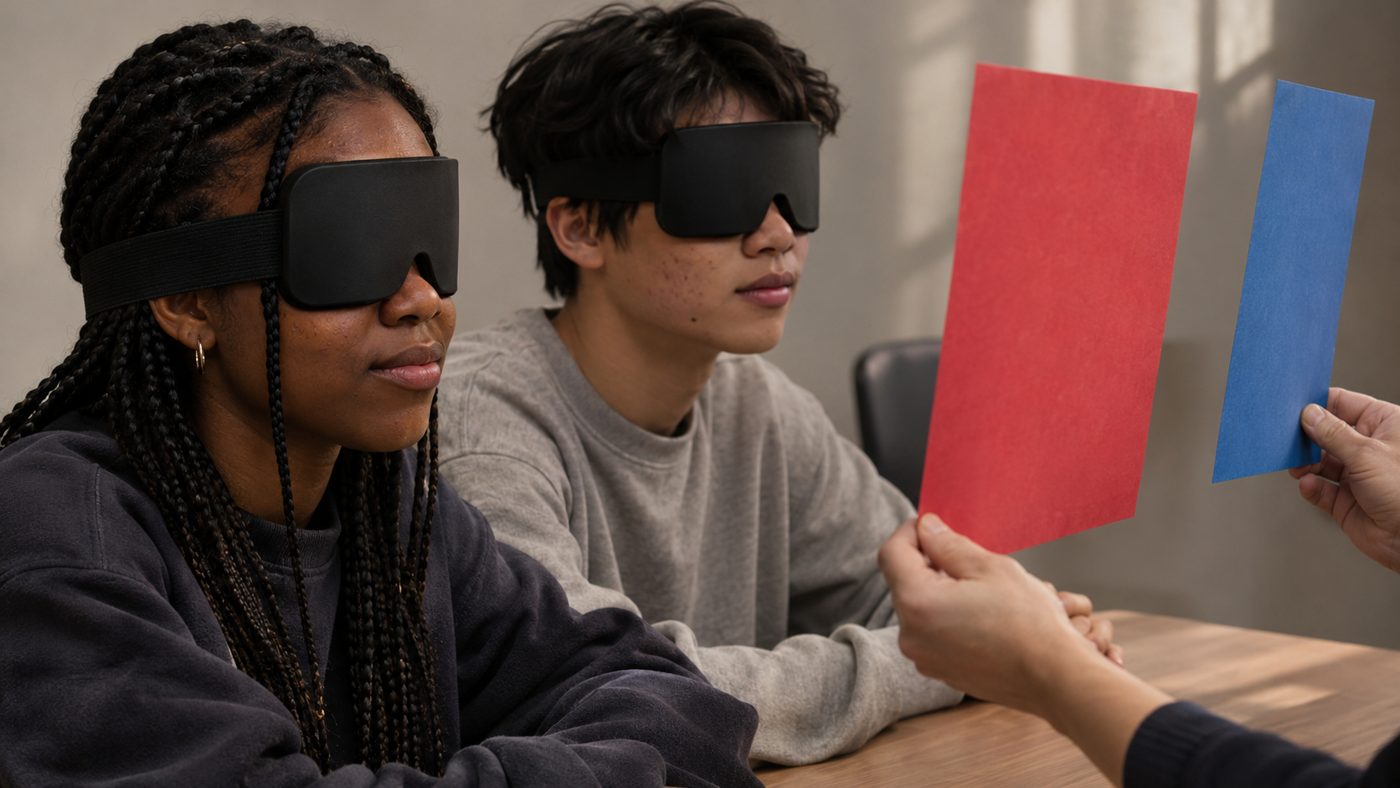
Exploratory hypothesis: self-regulation as biofeedback. In partner practice, feedback (“Actually, it’s blue. Let’s go again”) invites students to notice and adjust their inner state. The study explores, as a hypothesis, whether this works like biofeedback: does physiological self-regulation, measured as heart rate variability, improve over the course and go with gains in emotion regulation?
The first school site, a Los Angeles youth-serving nonprofit, is already on board; the class is planned there as an elective during the school day, with new groups of students each term. Additional school sites are being sought for 2027. Participants are ages 14 to 18: parental permission and student assent for those under 18, and adult consent for those who are 18.
The full practice, side by side.
In Phase 2, the comparison group does the same blindfolded art-making for the same time. Comparing the two tests the full Inner Insight package (guided attention, partner practice, progressions and openings together), not any single part of it. The difference is in what participants do, not in any claim about what they perceive.
Structured attention training under the blindfold: guided sense progressions (touch, sound, smell, light), partner practice, a ladder of steps that each make the exercise harder, insight sharing, and breath, movement and voice openings.
The blindfold, sensory materials, art-making, group time and session length. No guided attention exercises, no partner practice, no ladder.
Proof of concept first, then comparison.
Proof-of-concept pilot
A single group of students takes the course, starting with the touch and sound units, with no comparison group yet. It asks whether the course is feasible, safe and acceptable, whether the measures work, and what change looks like. Repeated with new groups of students each term at the first site, with measures before, after, and at one and three months. Sample size will be set with the faculty collaborator.
Controlled comparison
Inner Insight vs. blindfolded sensory art vs. a waitlist control (students continue their usual programming during the study, then take Inner Insight the following term) at the first site and at additional sites as they join. Random assignment where possible.
Ready-made pieces for a fundable research program.
A school site on board
A youth population ages 14 to 18 in a school-day setting. The site already collects standard anxiety, depression and well-being measures at intake, available as baseline with a data agreement.
A clear path to a controlled comparison
A simple proof of concept comes first. Phase 2 then adds an active comparison (the same blindfolded art-making without the practice) and a waitlist control, to separate the practice from art, novelty and adult attention.
A mechanism to test
Do attention and body awareness (interoception) explain changes in emotion regulation, social-emotional skills and self-esteem? And does the practice work like biofeedback, building physiological self-regulation? This connects to work on interoception, mindfulness, heart rate variability biofeedback and arts-based social-emotional learning.
Three papers
A feasibility pilot, a mechanism paper, and a controlled multi-site comparison: a dissertation-sized program with publications along the way.
Built to travel
A facilitator manual, a fidelity checklist and a second facilitator, with added sites planned toward evidence-based practice status for schools.
Current priorities
School-based social-emotional learning, youth mental health and emotion regulation, and arts and health research.
A practice studied for its effect on mental health.
Inner Insight examines how an arts-integrated, blindfolded attention practice may affect young people's emotion regulation, social-emotional skills and self-esteem, along with anxiety and well-being. A later controlled comparison asks whether guided attention contributes benefits beyond blindfolded art-making alone.
The study focuses on students' mental health and experiences of the practice. Perception accuracy is outside its scope.
Sound Made Visible

The arts-integrated youth class is one hour, during the school day, with one facilitator and a clinician available. This real lesson from the sound unit, reviewed with a teaching-artist coach, runs 50 minutes.
What can I hear when I set aside what I expect to hear?
- 6minWelcome and warmupThe facilitator opens with the purpose: “Sound is vibration, and today we find out what it looks like and how much we can hear when we stop guessing.” Then, standing in a circle, the group counts to 20 aloud, one voice at a time, with no order and no signals.
- 8minListeningSound as vibration and how the ear turns it into hearing. Cymatics: students watch sand on a vibrating plate form patterns, hum low and high notes into a live plate, and describe what changes as the pitch rises. Then a short talk on the filter we listen through before anyone speaks.
- 2minGetting set upMasks and marker boards. Ground rules: 1. Have fun. 2. If you’re not having fun, take a break.
- 14minWhole-class listening exerciseMasked, the class listens as the facilitator scratches two sheets of colored cardstock, gives each sound its own describing word, and checks in together before the colors are introduced. Successes and challenges are both acknowledged; misses are never called wrong.
- 13minShapes by sound, in pairsAfter a short demo, one partner draws a square, a circle or a triangle while the masked partner listens and draws what they hear on their own board, going back and forth until their shapes match consistently. Then they compare boards and switch.
- 7minBoards up and reflectionEveryone shows a drawing. Reflection: When did your filter jump in today? What did you discover today about sound?
Masks are worn for every exercise, and participants can take theirs off at any time, with no explanation needed. They choose whether to share and when to try a harder step. In-class checks, like comparing drawing boards, are teaching feedback and are not recorded as study data. Units move through touch, smell, sound and light. Baseline surveys happen before the first class, outside class time.
Three short sittings, before the first class.
Surveys are split into three sittings of 15–20 minutes. The first two sittings are repeated after the class ends and at one and three months; the third is repeated once, after the class ends. Students are not surveyed after each class. Instead, the facilitator completes a short behavior checklist after every class.
| Sitting | Area | Measure | Items | When |
|---|---|---|---|---|
| 1 (core) | Emotion regulation (primary) | DERS-SF | 18 | Before, after, 1 and 3 months |
| 1 (core) | Social-emotional skills (key secondary) | CORE Districts SEL survey | ~25 | Before, after, 1 and 3 months |
| 1 (core) | Self-esteem (key secondary) | Rosenberg Self-Esteem Scale | 10 | Before, after, 1 and 3 months |
| 2 | Anxiety | GAD-7 | 7 | Before, after, 1 and 3 months |
| 2 | Depression | PHQ-9 or the adolescent PHQ-A, with same-day clinician follow-up on item 9 | 9 | Before, after, 1 and 3 months |
| 2 | Well-being | WHO-5 | 5 | Before, after, 1 and 3 months |
| 2 | Attention and hyperactivity, emotional symptoms, peer relationships, helping others | Strengths and Difficulties Questionnaire (SDQ), self-report | 25 | Before, after, 1 and 3 months |
| 3 | Body awareness (exploratory) | MAIA youth version | ~32 | Before, after |
| — | Physiological self-regulation (exploratory) | Heart rate variability (HRV): a 5-minute resting recording with a chest-strap sensor | — | Before, after; before and after one class at selected sessions |
| — | Behavior in class | Facilitator checklist | — | After every class |
| — | Engagement | Attendance and participation from existing records | — | Each term |
| — | Experience | Interviews or focus groups | — | After, 1 and 3 months |
Outcome surveys and interviews will be collected by someone other than the class facilitator wherever possible. The final set of measures and the survey load will be reviewed with the faculty collaborator.
Choice and care, built in.
- Anyone can remove the blindfold at any time, with no explanation needed.
- Intake screening, with a clinician deciding inclusion, and a clinician available during sessions.
- Seizure screening before any strobe light use. Participants with epilepsy or light sensitivity follow an adapted, strobe-free version of the session.
- Trauma-informed delivery: predictable routines, choice, restorative responses.
- No data collected before IRB approval; participants identified by code only.
From a proposal to a study across schools.
Scroll sideways to see the whole timeline. Dates from 2027 on are targets.
Related evidence.
Awe and well-being; interoception and mindfulness; sensory reduction; sensory and movement approaches to trauma; drama and art therapy; arts-based social-emotional learning.
- Feinstein, J. S., et al. (2018). Examining the short-term anxiolytic and antidepressant effect of Floatation-REST. PLoS ONE, 13(2), e0190292.
- Kaufman, E. A., et al. (2016). The Difficulties in Emotion Regulation Scale Short Form (DERS-SF). Journal of Psychopathology and Behavioral Assessment, 38, 443–455.
- Keltner, D., & Haidt, J. (2003). Approaching awe, a moral, spiritual, and aesthetic emotion. Cognition and Emotion, 17(2), 297–314.
- Kroenke, K., Spitzer, R. L., & Williams, J. B. W. (2001). The PHQ-9: Validity of a brief depression severity measure. Journal of General Internal Medicine, 16(9), 606–613.
- Lehrer, P. M., & Gevirtz, R. (2014). Heart rate variability biofeedback: How and why does it work? Frontiers in Psychology, 5, 756.
- Jones, A., et al. (2021). Exploring the Multidimensional Assessment of Interoceptive Awareness in youth aged 7–17 years. Journal of Clinical Psychology, 77(3), 661–682.
- Mehling, W. E., et al. (2018). The Multidimensional Assessment of Interoceptive Awareness, Version 2 (MAIA-2). PLoS ONE, 13(12), e0208034.
- Perry, B. D. (2009). Examining child maltreatment through a neurodevelopmental lens: Clinical applications of the Neurosequential Model of Therapeutics. Journal of Loss and Trauma, 14(4), 240–255.
- Rosenberg, M. (1965). Society and the adolescent self-image. Princeton University Press.
- Spitzer, R. L., Kroenke, K., Williams, J. B. W., & Löwe, B. (2006). A brief measure for assessing generalized anxiety disorder: The GAD-7. Archives of Internal Medicine, 166(10), 1092–1097.
- Topp, C. W., et al. (2015). The WHO-5 Well-Being Index: A systematic review of the literature. Psychotherapy and Psychosomatics, 84(3), 167–176.
Let's build this together.
I'm looking for a faculty collaborator to co-lead the feasibility pilot and give the study an IRB home, in whatever field the work fits. Longer term, I hope to keep developing and evaluating Inner Insight through doctoral study with a faculty mentor. If this work fits yours, I'd like to talk.
An arts-integrated course designed to build attention, calm and connection.
Ten one-hour lessons for young people ages 14 to 18, being aligned with the California Arts Standards and built around social-emotional learning. Students work blindfolded with touch, sound, smell and light, through games, drawing and reflection.
First school site is already on board. A Los Angeles youth-serving nonprofit will offer it as a school-day elective once the study is approved.
Slow down, pay attention, play.
Listen and notice
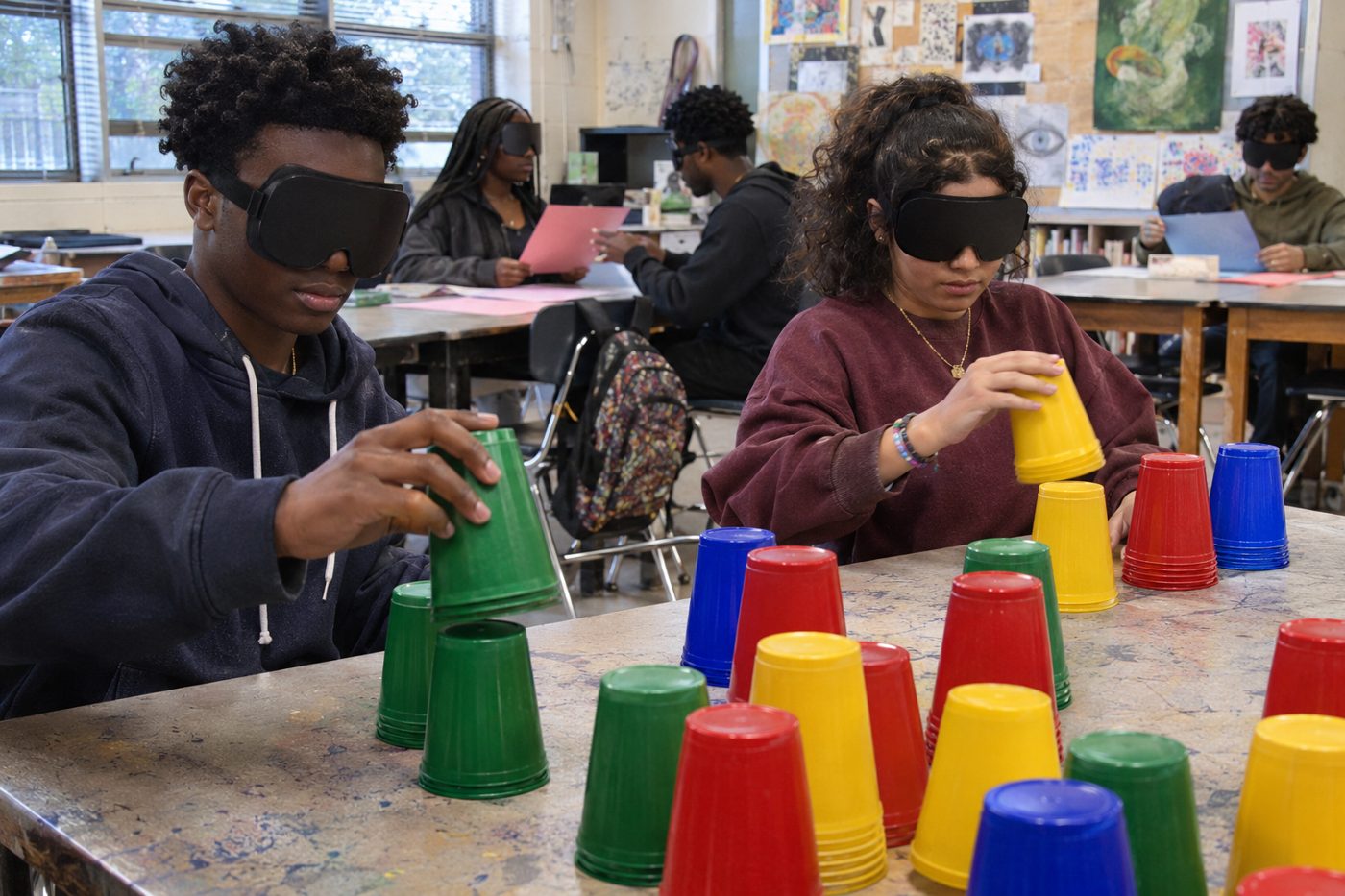
Students slow down and pay close attention to touch, sound, smell and light, and learn to notice the expectations they bring before anyone speaks.
Draw and reflect
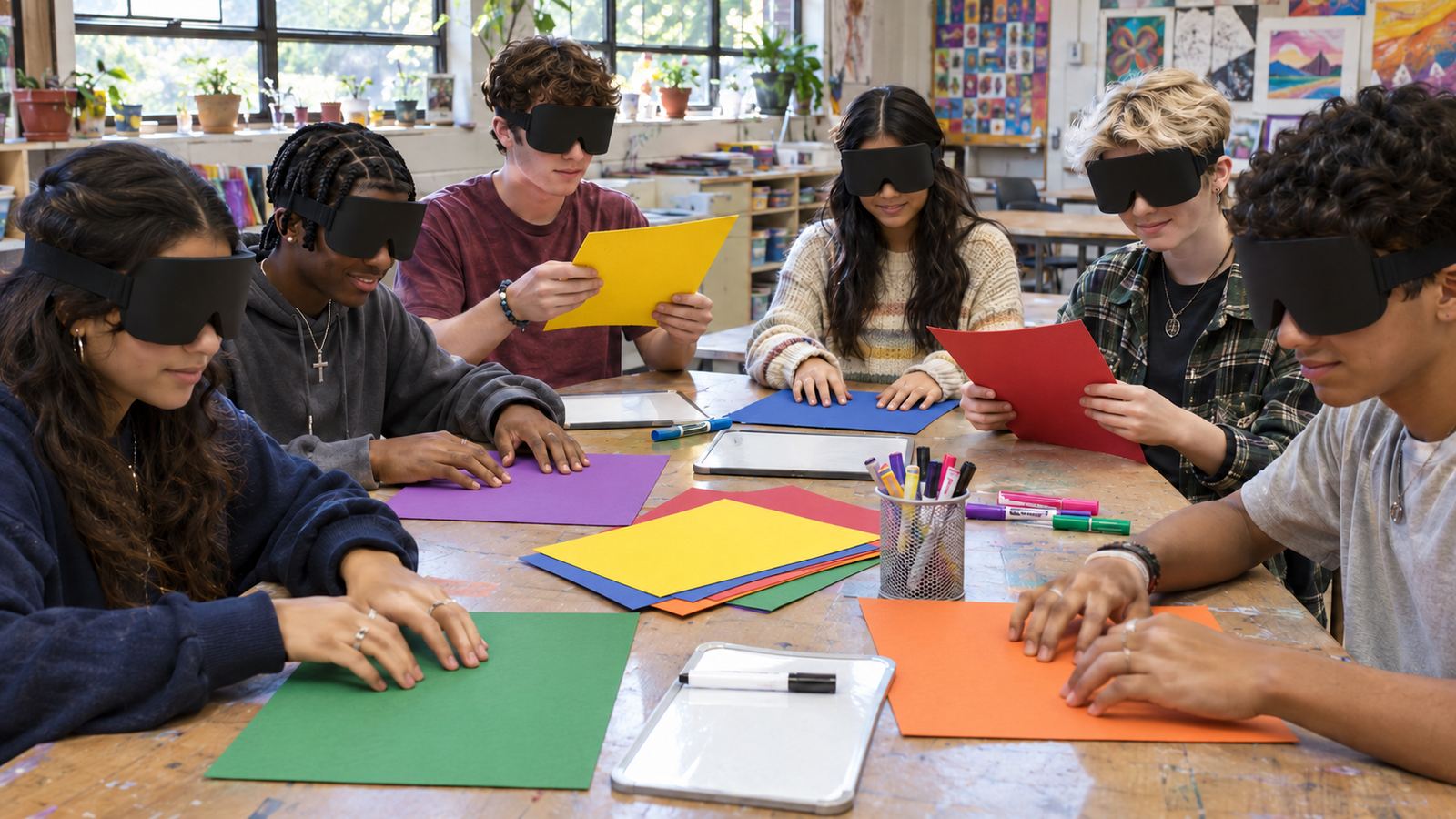
They draw what they hear, describe sounds in their own words, and talk about what they notice in each other's drawings.
Play and practice
Partner exercises, group games and steps that get harder as students feel ready. Misses are cheered, never called wrong.
Choose
Masks are on for every exercise, and anyone can take theirs off or take a break at any time. Students choose whether to share and when to try the next step.
Ten lessons, four senses.
The course moves through touch, sound and smell, then six lessons of light, and ends with a celebration of everything learned. Every lesson follows the same rhythm: a warmup game, a short lesson, a whole-class exercise, partner practice, and a closing reflection.
Touch
Students explore textures and colored materials by touch with a partner, and describe what they feel in their own words.
Sound
Students learn how sound travels as vibration, watch it become visible patterns in sand, and draw what they hear.
Smell
Students smell plain, unscented blocks of different colors and practice noticing the subtle differences between them, describing each one in their own words.
Light
Over six lessons, students move from colored light through transparent materials to opaque colors, daylight outdoors, shapes, and finally reading, building steadier attention over time.
Sound Made Visible
One lesson from the sound unit, to show how a class runs. Students learn that sound is vibration, watch sand form patterns on a vibrating plate, give each sound their own describing word, and draw shapes they hear a partner draw.
What can I hear when I set aside what I expect to hear?
Prof.VA:Cr2.1Engage in making a work of art or design without having a preconceived plan.Prof.VA:Re7.1Hypothesize ways in which art influences perception and understanding of human experiences.CASEL · Relationship skillsThe abilities to establish and maintain healthy and supportive relationships and to effectively navigate settings with diverse individuals and groups.Standards alignment reviewed with a teaching-artist coach.
One hour a week, during the school day.
- One-hour classes during the school day, once a week, led by a teaching artist with school staff present.
- Materials provided: masks, marker boards, sensory and art supplies.
- A counselor or clinician available during class; anyone can remove the mask at any time.
- Seizure screening before any strobe light use, with a strobe-free version for anyone at risk.
- Proposition 28 arts funding may help pay for a teaching-artist residency, depending on district eligibility and spending rules.
Become a study site.
Inner Insight will be studied as a way to support students' mental health and social-emotional growth. We're inviting two schools to join as study sites from fall 2027, once the pilot at the first site is underway.
Kedra Dawkins
Teaching artist, coach, and MSW student bringing together art, attention, and youth mental health.

Kedra Dawkins leads Inner Insight Lab, where she is developing an arts-integrated course that invites young people to slow down, explore their senses, and express what they notice.
Her work brings together 18 years in film and television art direction and production design, including Renaissance: A Film by Beyoncé and Black Panther: Wakanda Forever, with professional coaching and graduate study in social work. She holds a BFA in Technical Theatre from Cal Poly Pomona and an MFA in Production Design from the American Film Institute. She is currently pursuing her MSW at Alliant International University and participating in the ECF Teaching Artist Program.
Through Inner Insight, Kedra is adapting blindfolded sensory-awareness practices into one-hour classes built around art, play, reflection, and student choice. Students have room to experiment, celebrate mistakes, and practice paying attention to themselves and one another.
She is preparing to study the course’s effects on emotion regulation, social-emotional skills and self-esteem, as well as anxiety and well-being, with the long-term goal of bringing a carefully evaluated program to California public and charter schools.
Kedra is looking for a faculty collaborator to co-lead the pilot, and in the longer term a doctoral home where she can keep developing, evaluating and expanding this work.
ORCID iD and CV coming soon.
Let's talk.
Faculty, doctoral programs, schools and districts: send a note and Kedra will reply.